




"Common Trust has been a true partner — helping us fully understand what we were trying to build and how to do it the right way."
Luke Leising · Founder, Guidon
Read Guidon's case study →Start typing to search.
Searching…
No results. Press Enter to search the whole site.

Imagine an ownership transition where everyone wins.
Common Trust helps owners sell to an Employee Ownership Trust so they can protect what they’ve built and reward the team that built it.
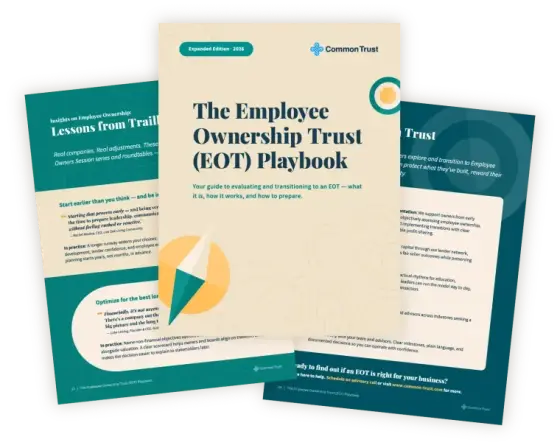
Not ready to talk? Start with the EOT Playbook
We are the industry leader in supporting EOT transactions
enterprise value transitioned to employee ownership
team members brought into employee ownership
client satisfaction from owners across industries and sizes
Here are a few of the owners we’ve worked with.
What is an EOT?
An Employee Ownership Trust (EOT) is a trust that holds company ownership for the benefit of employees.
Instead of individual employees purchasing shares, the trust owns the business on behalf of the team. Employees don’t take on personal debt, and ownership sits at the company level.
Why owners choose an EOT
It’s about who carries forward what you’ve built — the company, the culture, and the relationships that don’t show up in a spreadsheet.

Our process
From first call to after the transaction, we’re with you every step of the way.
A no-pressure conversation about your goals, your timeline, and whether employee ownership could fit.
Model scenarios and see what’s viable before making commitments.
We lead the transition alongside your existing advisors.
Governance, education, and financial oversight after the deal closes.
You don’t have to commit to anything before you’re ready.
Book your free advisory call
Start with the EOT Playbook to see how owners are using EOTs, and what to consider before you decide.
Download the playbookReal outcomes, built through EOTs
"Common Trust has been a true partner — helping us fully understand what we were trying to build and how to do it the right way."
Luke Leising · Founder, Guidon
Read Guidon's case study →
"Our transition to an EOT was well planned and supported by Common Trust. Their experience made the planning and project management process much easier."
Ben Wihebrink · CFO, Cypress Valley Meat Co.
Read Cypress Valley's case study →
"Our experience with Common Trust started with purpose — with the why behind what we were really trying to do. Leading with how to protect culture and values over time just made a lot of sense."
Rodney Evans · Partner, The Ready
Read The Ready's case study →
"Their financial backing was helpful, but what we appreciated most was their care and genuine concern. They're people we want to stay connected with forever."
Kevin Clegg · CEO, Clegg Auto
Read Clegg Auto's case study →
"This is a process you really want to get right. We evaluated many options and Common Trust was definitely the right partner for planning our transition."
Brad Herrmann · CEO & Founder, Text-Em-All
Read Text-Em-All's case study →Compare your options
| Compared on | Employee Ownership Trust | ESOP | Sale to PE or a competitor |
|---|---|---|---|
| Who buys | A trust, on behalf of all employees | A retirement plan for employees | An outside buyer |
| Company stays independent | Yes, designed for the long term | Usually, though it can be resold later | No |
| Ongoing paperwork | Lighter | Heavier: yearly valuation and federal retirement-plan rules | None for you after the sale |
| Federal tax breaks | Fewer today | Significant | Standard capital gains |
| Often the best fit for | Owners who care most about legacy, simplicity, and independence | Larger companies where the tax breaks outweigh the paperwork | Owners who want the most cash at closing |
Compare an EOT with
Employee Ownership Trust
ESOP
Sale to PE or a competitor
Simplified for comparison. Not legal or tax advice.
Read the full EOT vs. ESOP guideFor CPAs, attorneys, and wealth advisors
We work alongside your client’s advisors, not in place of them. Let’s get to know each other first, so you know who to call when a client starts weighing their options.