
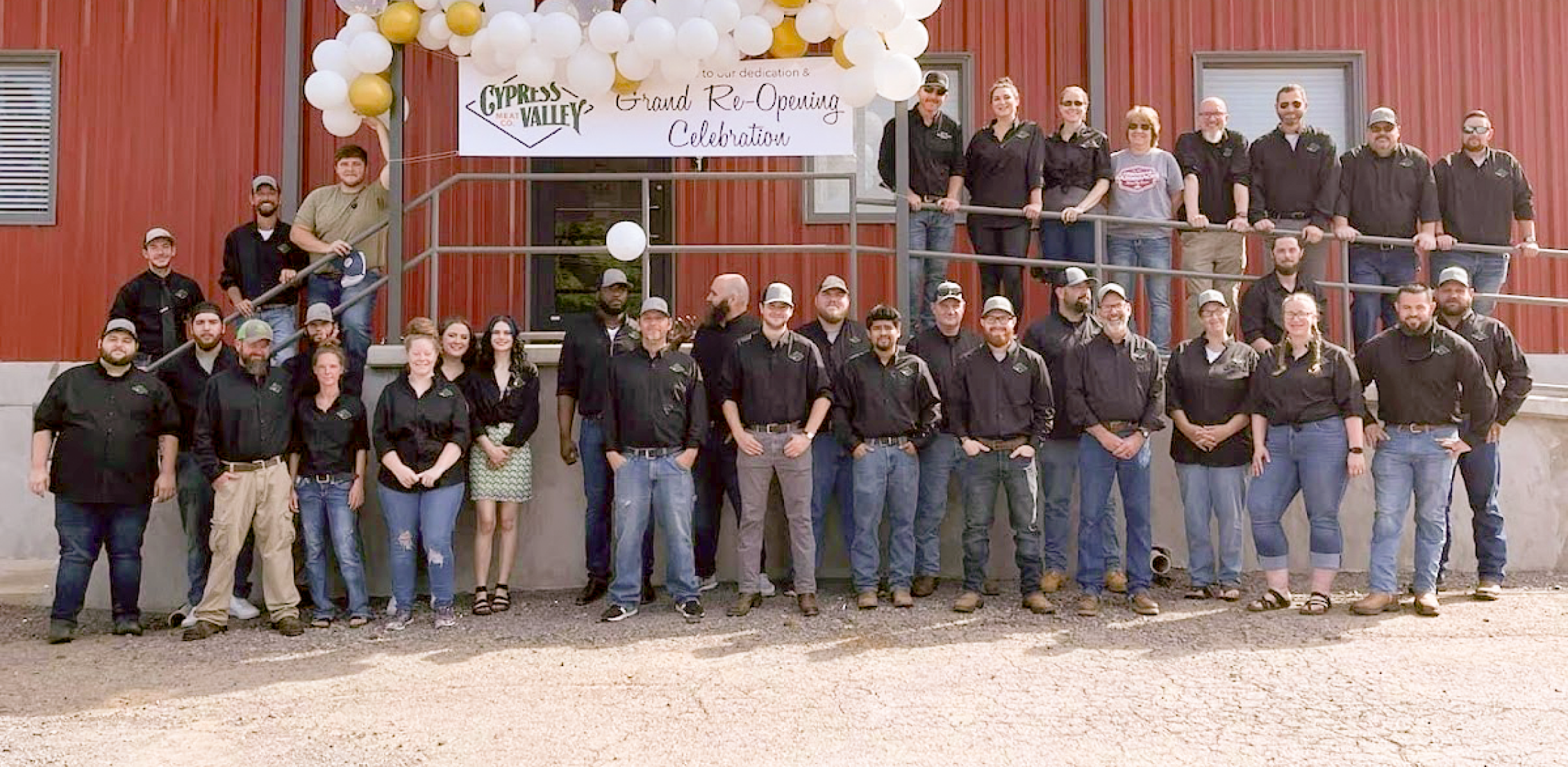
Cypress Valley Meat Company has always believed that the people doing the hard, hands-on work deserve a real share in the success they help create. In an industry known for physically demanding work and high turnover, Cypress Valley built a culture rooted in transparency, shared success, long-term opportunity, and recognition programs like Meat the Rewards that celebrate team contributions.
Founder Andy Shaw centered the company on that belief, often telling his team, “We’re going to retire together.”
After Andy’s passing in 2021, Cypress Valley began exploring long-term succession options that could protect the company’s future and carry that commitment forward. Preserving their culture required an ownership structure that could handle the financial realities of a slim-margin, high-volume business while maintaining long-term stability. That search ultimately led to an Employee Ownership Trust (EOT).
The challenge: Preserving a people-first philosophy in a demanding industry
Cypress Valley operates in a low-margin, high-volume environment where workforce needs, capital requirements, and seasonality create constant pressure. Even as the company expanded across five locations and served more than 2,600 independent farmers, the leadership team stayed committed to a people-first approach rooted in transparency, shared success, and long-term opportunity.
The challenge was choosing an ownership structure that could:
Protect the company’s commitment to shared success while keeping ownership locally rooted
Maintain financial stability without taking on complex or costly obligations
Give employees a real stake in future growth through a structure that’s simple to operate
This wasn’t just about succession planning — it was about choosing a structure that aligned with both Cypress Valley’s values and the realities of its industry.
The process: Evaluating employee ownership options
Employee ownership had been part of internal conversations for years, but Andy’s passing in 2021 created a natural inflection point: a moment to revisit sustainable succession strategies and ensure the company could continue honoring its people-first commitments.
CFO Ben Wihebrink brought deep experience with employee-ownership structures — from worker cooperatives to agricultural cooperatives to ESOP exploration — helping the team evaluate options with clear criteria: protect the company’s independence, keep the model simple, and ensure employees could benefit in a meaningful way.
ESOP (Employee Stock Ownership Plan)
ESOPs offered meaningful tax advantages, but the structure’s ongoing valuations and repurchase requirements didn’t align with Cypress Valley’s financial strategy or the way the company manages capital across multiple facilities. In a business where equipment, facilities, and workforce investment are essential, the team needed an ownership model with more predictable cash planning.
Trust-based models
As the team explored alternatives, they looked for a structure that could:
Support ongoing capital needs in a margin-sensitive business
Adapt to a C-corp holding company with multiple LLCs
Provide more immediate benefit to employees through profit-sharing
Enable governance participation during employment, not only at exit
These requirements led the leadership team toward an Employee Ownership Trust — a model that could be designed around Cypress Valley’s operating realities, cash-flow profile, and long-standing commitment to shared success.
“Because our margins are small, we needed a structure that was both flexible and meaningful for employees. The EOT lets our team participate in profit-sharing and governance while they’re here — without future repurchase obligations.” — Ben Wihebrink, CFO, Cypress Valley Meat Company
The solution: A flexible EOT, designed for a thin-margin business
Working with Common Trust, Cypress Valley designed an ownership structure that reinforced its culture and long-term goals without adding unnecessary complexity or administrative load.
Why the EOT worked
Cultural alignment: Reinforced Cypress Valley’s long-standing values of shared success, transparency, and people-centered leadership.
Financial resilience: Avoided the future repurchase obligations common in ESOPs, allowing for predictable, long-range cash planning.
Flexible design: Supported a C-corp holding company with multiple LLCs — mirroring how the business already manages risk and operations across locations.
Employee benefit: Built on existing profit-sharing practices (“Meat the Rewards”) and enabled broader, more immediate participation without employee buy-in.
Governance clarity: Created a balance of employee stewards, family representation, and independent expertise to support long-term alignment.
“The EOT was the best way to protect our employees from risk while allowing multiple options for them to benefit when the business is thriving.” — Brandon Dunn, President & CEO, Cypress Valley Meat Company
Financing the EOT transition
Cypress Valley completed the transition using a blend of seller notes and creative redemption agreements — an approach tailored to the company’s cash-flow profile that allowed operations to continue uninterrupted.
After the transition: Culture, clarity, and shared success
When Cypress Valley became employee-owned in July 2025, the transition strengthened what the company already did well: transparent communication, strong plant-level leadership, and a culture that values shared effort. The EOT gave the company a durable structure for long-term stability, while employees gained a clearer understanding of how their work contributes to the company’s results.
Early impact on employees
Cypress Valley expanded its existing profit-sharing into a simple, easy-to-understand model that grows with tenure, giving employee owners a more tangible connection to company performance.
Stronger engagement, stronger culture
Rather than reshaping the business, the EOT sharpened practices already in motion — quarterly open-book financial reviews, regular town halls across all locations, and highly engaged plant-level teams.
Long-standing traditions like recognition programs and community involvement now carry even more meaning because employees directly share in the company’s progress.
“When we win, we know exactly who benefits — our employee owners, our farmers, and our local food system.” — Brandon Dunn, President & CEO, Cypress Valley Meat Company
Lessons for leaders exploring employee ownership
Cypress Valley’s journey offers valuable insight for companies in essential, labor-intensive industries:
Start with values. Ownership should reinforce what already makes the company strong.
Design for your operating reality. Margin-tight, capital-heavy sectors often benefit from flexible, predictable models.
Keep it simple. Profit-sharing and governance don’t need to be complex to be meaningful.
Honor legacy, but design for the future. The right structure should protect both culture and long-term resilience.
Wondering if employee ownership makes sense for your company?
Common Trust helps business owners, founders, and advisors explore employee ownership and design Employee Ownership Trusts (EOTs) that align with their goals, financial structure, and long-term vision.
If you’re beginning to evaluate whether an EOT — or another employee-ownership model — could be a fit, we’re here to walk through your options, answer questions, and share what we’ve seen work in similar situations.
Schedule a free advisory call to explore whether employee ownership could be right for your company.