
PLAYBOOK
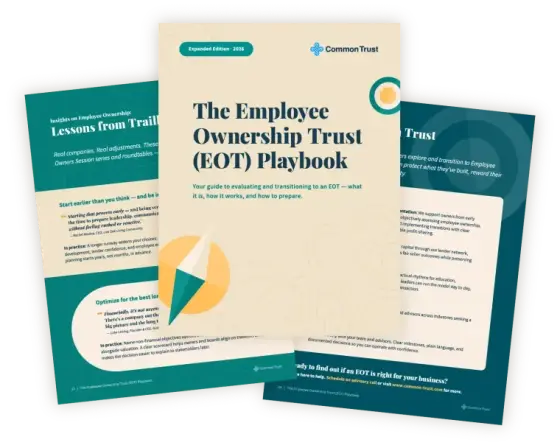
The Employee Ownership Trust (EOT) Playbook
Your guide to evaluating and transitioning to employee ownership, grounded in real stories, deal terms, and practical tools.
What is an Employee Ownership Trust (EOT)?
An Employee Ownership Trust (EOT) is a trust that holds company ownership for the benefit of employees.
Instead of individual employees purchasing shares, the trust owns the business on behalf of the team. Employees don't take on personal debt, and ownership sits at the company level.
For owners, an EOT can provide a fair market-value exit and preserve independence and leadership continuity. For the business, it creates a long-term ownership model designed to support stability and shared success.
EOTs operate under trust law rather than ERISA, allowing flexibility in governance and implementation. They sit alongside other employee ownership models, including ESOPs and worker cooperatives - each with its own structure and considerations.
Employee ownership is more than an exit - it's a long-term operating model.
More business owners are incorporating employee ownership into their succession planning - not because it's trendy, but because it offers a way to sell the business without sacrificing what they've built.
Selling to a third party can maximize price, but it often changes control. Internal transfers can preserve culture, but may not fully address liquidity. An EOT sits between those paths: it enables a fair exit and keeps the company independent and rooted in its people.
But the transaction is only one part of the story. Governance design, profit-sharing, and internal communication shape what employee ownership looks like in practice. The operating model matters as much as the deal structure.
The 2026 EOT Playbook walks through both sides: the transaction and the operating model.
Inside, you'll find:

A clear explanation of employee ownership and how EOTs compare to other models

Real case studies from across industries, including deal structure and financing approaches

Practical lessons on governance, profit-sharing, and communication after closing

A concise FAQ addressing common questions from owners, advisors, and leadership teams
Join the thousands of companies across the U.S. that have already chosen employee ownership.





Whether you're planning ahead, considering how to sell your business to your employees, or evaluating succession options, the EOT Playbook can help clarify your next steps.
Schedule an advisory call to determine whether an Employee Ownership Trust aligns with your succession plan and long-term goals. No pressure - just practical guidance tailored to your business.