.png)
October is Employee Ownership Month — a chance to celebrate the thousands of employee-owned companies in the U.S. and spotlight the growing number of founders choosing this path for succession.
Behind the recognition is a clear reality: succession planning in 2025 looks very different than it did a decade ago.
For many business owners, stepping away from the company they’ve built comes with more questions than answers: What will happen to the team? The culture? The community? And how do you find a buyer who truly values what’s been created?
Traditional exits often leave those questions unresolved — and likely contribute to why 75% of owners regret their sale within a year [1]. A strategic or private equity sale may look good on paper, but the trade-offs can lead to team disruption, cultural change, or even shuttered businesses.
That’s why more founders are turning to employee ownership: a path that creates liquidity while protecting what matters most — people, purpose, and long-term independence. It rewards the teams who helped build the business, safeguards culture, and keeps jobs rooted in local communities.
The succession challenge facing business owners
We’re in the midst of a major generational shift: an estimated 37% of owners are expected to seek a sale in the next few years[2]. And with a wave of retirements already underway, many are realizing that succession planning is more complex — and less certain — than anticipated.
Two-thirds of business owners don’t have an exit strategy [2]
41% of net worth for people ages 55–69 is tied to a privately held business [3]
Even profitable, well-run companies can struggle to find the right buyer or navigate a smooth transition:
80% of listed businesses never find a buyer [4]
47% of key employees leave after a merger or acquisition [5]
Businesses acquired by private equity see a 10x higher bankruptcy rate [6]
These realities often leave founders weighing a quick payout against protecting their employees, culture, and the future of the business.
Employee ownership: a proven alternative exit
For many founders, the goal isn’t just to exit — it’s to do so on their own terms. Employee ownership provides a way to achieve fair market value while ensuring the company, its mission, and its people continue to thrive.
At its core, employee ownership means selling the business to the people who know it best: your employees. It allows owners to:
Exit at a competitive, fair market price
Preserve jobs and company culture
Empower employees to carry the business forward
Beyond the transaction, this model gives founders confidence that leadership can transition smoothly, employees share in the rewards of ownership, and the company remains a vital part of its community.
The impact is measurable. Research shows that employee-owned companies deliver durable performance and resilience, often outperforming peers:
"Ownership unleashes the care factor — when people care more, every bit of what you do gets better." — Kevin Clegg, CEO, Clegg Auto
Ultimately, business owners aren’t just securing liquidity — they’re leaving behind a legacy of stability, continuity, and shared prosperity.
Fact vs. fiction: myths about selling to employees
Despite its momentum, myths about employee ownership still hold some owners back. Here are a few we hear most often — and what’s actually true:
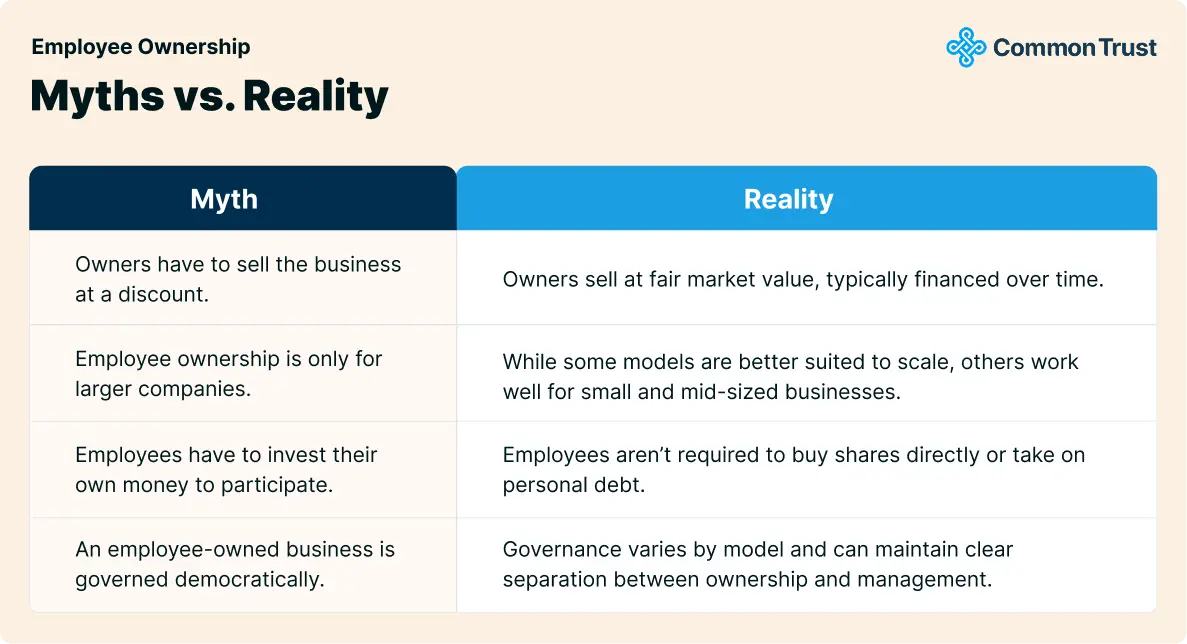
Myth: Owners have to sell the business at a discount. The reality? Owners sell at fair market value, typically financed over time.
Myth: Employee ownership is only for larger companies. While some models are better suited to scale, others work well for small and mid-sized businesses.
Myth: Employees have to invest their own money to participate. With models like the Employee Ownership Trust (EOT), employees aren't required to buy shares directly or take on personal debt.
Myth: An employee-owned business is governed democratically. In reality, governance varies by model and can maintain clear separation between ownership and management.
Exploring employee ownership models
There’s more than one way to structure an employee ownership transition. Each approach comes with distinct benefits and considerations — the right path depends on company size, goals, and the legacy you want to leave.
1. Employee Ownership Trusts (EOTs)
In an EOT, some or all shares are sold into a trust that holds the business for the benefit of all employees.
Why owners choose it: No employee buy-in required; lower setup and ongoing costs than ESOPs; no repurchase obligations; continuity of culture and leadership.
Considerations: May require more employee education; fewer financing and tax incentives than ESOPs (though some states, like Colorado, are changing this).
Well-suited for: A wide range of industries and company sizes, including small-to-mid-sized businesses looking for a flexible, founder-friendly path.
2. Employee Stock Ownership Plans (ESOPs)
An ESOP is a regulated retirement plan, regulated by ERISA under the Department of Labor, where employees gradually gain ownership through a trust.
Why owners choose it: Strong tax advantages; well-established framework; ties employee success to company performance.
Considerations: Higher setup and administrative costs; ongoing oversight via ERISA (Department of Labor); companies must buy back shares when employees depart.
Well-suited for: Larger businesses with the financial and operational resources to sustain them.
3. Worker Cooperatives (co-ops)
In a co-op, employees directly, and collectively, own and govern the business.
Why owners choose it: Deep employee participation; equal ownership; democratic governance.
Considerations: Requires cultural alignment and a shift in governance; less common in capital-intensive or highly hierarchical industries.
Well-suited for: Values-driven companies or sectors with a cooperative tradition (e.g., food, retail, and certain service industries).
4. Management Buyouts (MBOs)
An MBO transfers ownership to a small group of existing leaders.
Why owners choose it: Leadership continuity; a straightforward transaction; doesn’t require a full employee transition.
Considerations: Concentrates ownership among a few; may not create broad employee participation.
Well-suited for: Businesses where leadership stability is the top priority (e.g., professional services firms or family businesses).
Blending ownership models
Some companies combine approaches — for example, pairing an MBO with an EOT to balance leadership continuity with broad-based employee benefit.
Employee ownership in action: Clegg Auto
So, what happens when a company puts its employees in the driver’s seat?
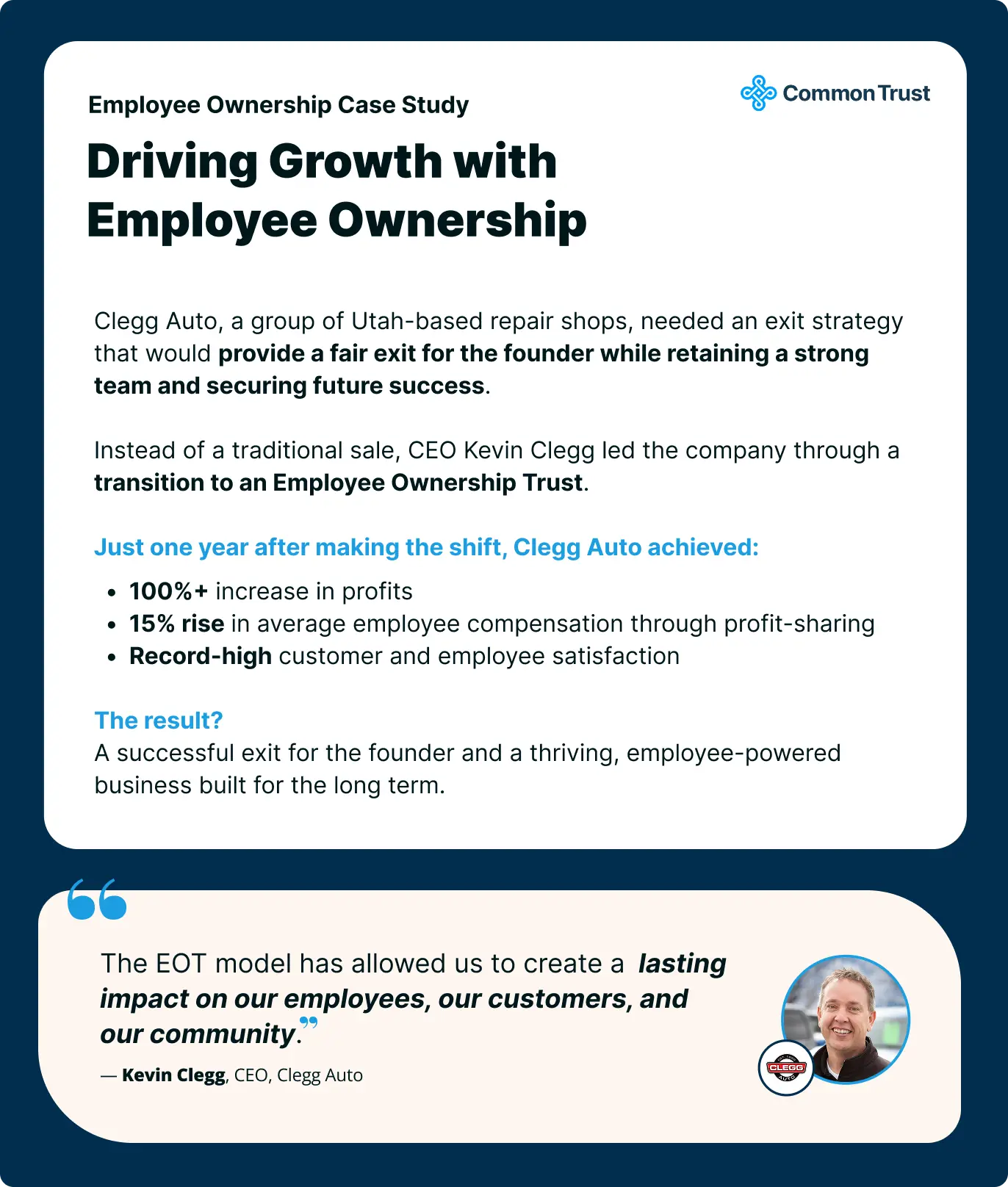
For Utah-based Clegg Auto, succession wasn’t just about finding a buyer. It was about balancing a fair exit for the founder with continuity for the team and community, ensuring employees were rewarded for their work and the business stayed rooted locally.
By transitioning to an Employee Ownership Trust, the company did both — and saw record-breaking results.
What we’re celebrating this month
Employee Ownership Month is about more than recognition. It’s about celebrating pioneers who are safeguarding culture, rewarding employees, and keeping businesses independent and local — while proving what’s possible for communities nationwide.
Founders showing that succession can be both financially fair and people-first
Employees building wealth, stability, and stronger communities
States taking action to expand access — from Colorado’s new tax incentives and California’s Employee Ownership Act, to proclamations in Hawaii, Indiana, Iowa, Nebraska, and North Carolina officially recognizing October as Employee Ownership Month
Together, these milestones reflect a growing movement: one that’s reshaping how owners exit, how employees share in success, and how communities keep vital businesses local for the long term.
"What I was really inspired by with an employee ownership model was that the ownership was staying local, so that way it was helping the community… it helped my team members close that wealth gap." — Miren Oca, Founder & Director, Ocaquatics Swim School
Taking the next step towards employee ownership
The hardest part of succession isn’t deciding whether to exit — it’s finding a path that balances financial outcomes with the future of the people and culture you’ve built. Employee ownership offers that balance.
At Common Trust, we partner with founders, leadership teams, and advisors to design employee ownership transitions tailored to each company’s goals. We help owners achieve liquidity while creating lasting stability for employees and communities.
This Employee Ownership Month, see what the future of succession could look like for your business. Schedule an advisory call with our team today.